
Emery County Court Records After a Jail Arrest
After an Emery County jail arrest, the custody record and the court record answer different questions. The jail side documents the arrest, booking date, arresting agency, intake allegations, custody status, and release or hold information when those details are available. The court side begins when the prosecutor files a criminal case in the proper Utah court. From that point forward, the important record is not just that an arrest happened. It is the charging document, the case number, the court location, the scheduled hearings, the bond or detention order, and the current status of each count.
The Emery County Attorney's Office prosecutes crimes committed in the county through Emery County Justice Court, the Seventh Judicial District Court, and Juvenile Court. The county attorney page names Mike Olsen as County Attorney and W. Brent Langston as Deputy County Attorney for criminal prosecution. Those local prosecutor facts matter because a jail booking can list an initial allegation before the prosecutor files, amends, reduces, or declines charges. For custody-side details, a natural next step is the local jail inmate records process; booking photographs are a separate topic handled with Utah's booking-photo limits through jail roster mugshots.
From Emery County Booking to Court Case
A typical local pathway starts with arrest by the Emery County Sheriff's Office, a municipal officer, Utah Highway Patrol, or another agency with authority in the county. If the person is booked locally, Emery County Jail records the intake event at the Castle Dale sheriff and jail campus. That booking is not the final court charge. The formal case comes after review by the prosecuting office and filing in the court that has jurisdiction over the alleged offense.
Justice Court commonly handles many misdemeanor, traffic, and local ordinance matters. District Court handles felony matters and other cases assigned to the Seventh Judicial District. Juvenile Court is separate for youth cases. Public access differs by case type, age of the person, court rules, and record classification. When a search produces no public result, that can mean no case has been filed yet, the case is in a restricted category, the wrong court was searched, the name is misspelled, or the case is too new to appear in the public system.
Searching Utah Xchange for Court Records After an Arrest
Utah Courts Xchange is the public case-search system for district and justice court case information. It can help locate formal court records after an Emery County arrest, including case number, filing date, party information, case history, and public documents where available. Xchange is a court index and document-access system, not a jail custody roster. A person may have a pending court case even if that person has posted bond, been released on conditions, transferred, or moved into another custody system.
Use the Xchange search fields with the most precise information available. The exact case number is best when it appears on a citation, warrant, notice, bond paperwork, or court notice. If the case number is unknown, search by party name and narrow results with birth date, court location, case type, date range, or citation number when those fields apply.
| Field Label | Type | Required | How It Helps |
|---|---|---|---|
| Jurisdiction | Dropdown or filter | Used for scope | Limits the search to the relevant court or court level. |
| Search Type | Dropdown or radio option | Yes | Chooses case number, party name, citation, or another route. |
| Case Number | Text | Required for case-number search | Best route when a court notice or citation gives the exact number. |
| Last Name / Company | Text | Required for name search | Primary party-name field for defendant searches. |
| First Name | Text | Optional or used for person search | Reduces same-name matches. |
| Case Type | Dropdown or filter | Optional | Can narrow to criminal, traffic, or other case groups. |
| Birth Date | Date | Optional | Useful when multiple defendants share a similar name. |
| Citation Number | Text | Required for citation search | Often useful for traffic or justice court matters. |
| Location | Dropdown or filter | Optional | Can focus results on the Emery County court location. |
| Date Range | Date fields | Optional | Limits results by filing or search date range. |
The Xchange result fields described by Utah Courts include county, court location, case type, case number, filing date, party name, birth date when available, party code, case history, and documents. Those fields are useful for tracking court records after a jail arrest, but they should not be read as proof of current jail housing.
Utah Courts identifies Xchange as the public case-search route for court records.
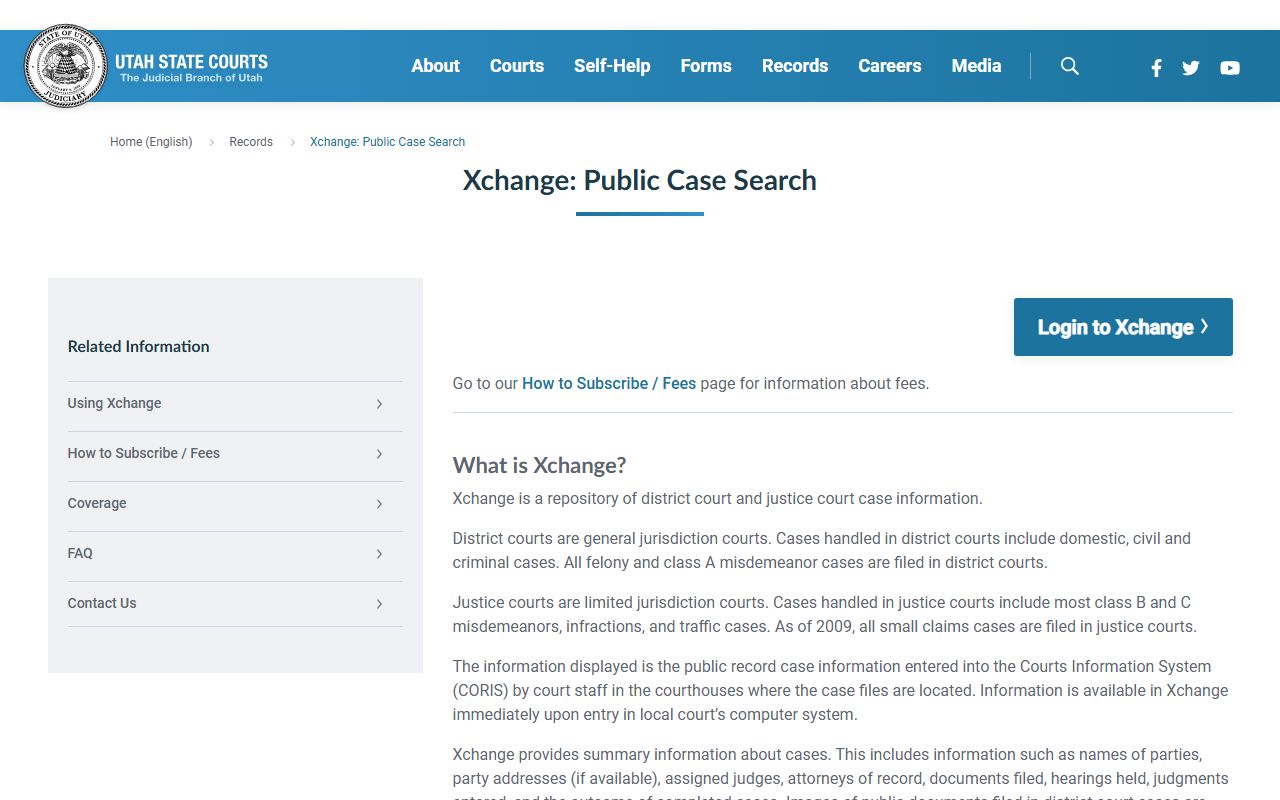
The Xchange screenshot matches the court-record lookup task because it points to filed case information, not local jail population or mugshot data.
Using MyCase When You Are a Party
Utah MyCase is different from Xchange. It is built for parties to access their own case history, filed papers, scheduled hearings, and certain filing tools after account setup. It is not a broad public inmate search and should not be used as a substitute for jail custody confirmation. For a defendant, victim, or other party with proper access, MyCase may provide a clearer view of notices, filings, hearings, and case documents than a public name search.
MyCase is especially relevant when a person knows a case exists but needs filed documents or hearing information tied to that person's own case. If the question is whether someone is still physically held at Emery County Jail, the sheriff or jail remains the local custody channel. If the question is whether the prosecutor filed charges, whether a hearing is set, or whether a release order was entered, court systems and court clerks are the more direct route.
Utah Courts describes MyCase as party access for a user's own case information.
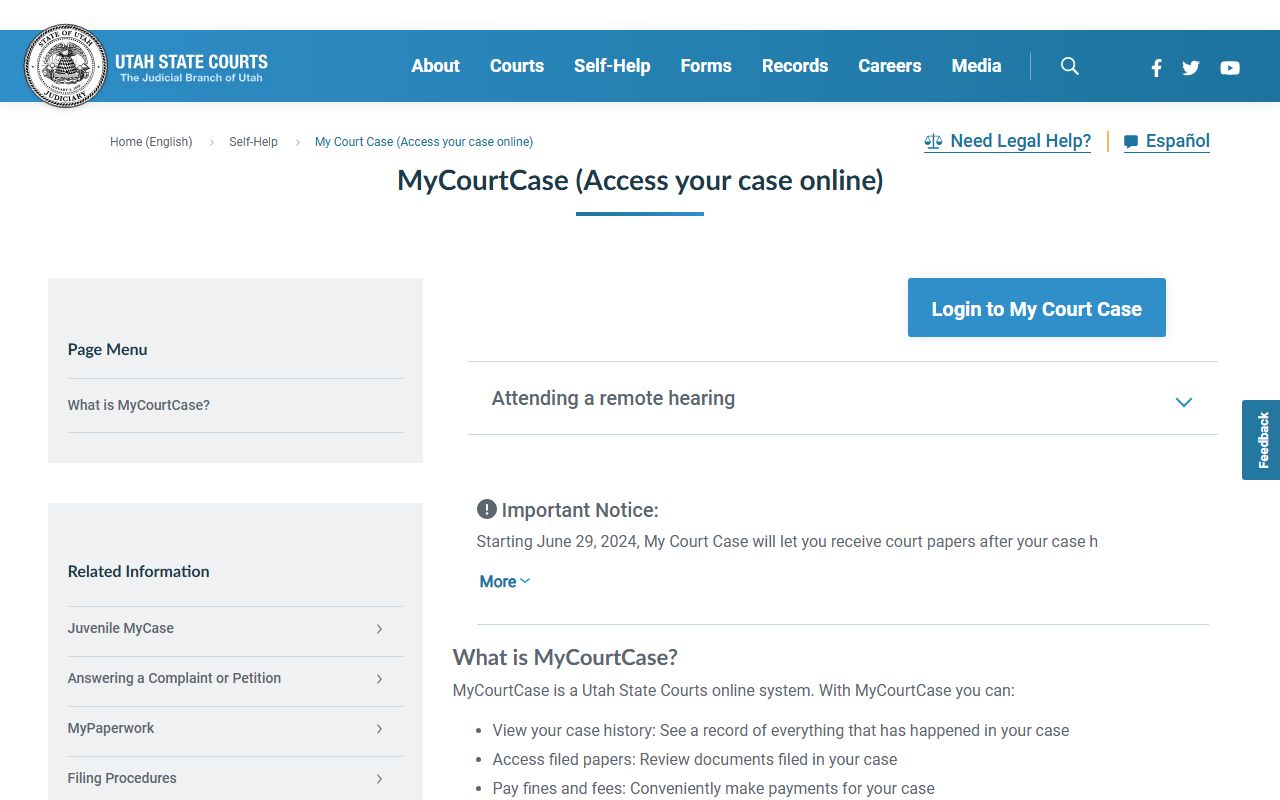
This access point is narrower than a public search, but it can matter after an arrest when a defendant needs notices, hearing details, or filed papers.
Charging Documents After an Arrest: Complaint, Information, and Indictment
The charging document is the bridge between a jail arrest and the court record. In routine local criminal practice, the document tells the court what offense is alleged, identifies the defendant, and begins or advances the prosecution. Emery County research identifies complaint, information, and indictment as the key terms to explain. The exact document used depends on the court level, offense type, prosecutor action, and Utah procedure.
| Document | Usually Filed By | Common Use | What to Check |
|---|---|---|---|
| Complaint | Officer or prosecutor depending on procedure | Often starts criminal proceedings, including many justice court matters | Offense name, statute or code citation, alleged date, court, and case number. |
| Information | Prosecutor | Common prosecutor-filed document in felony pathways | Whether charges changed from the booking allegation and whether the case is in district court. |
| Indictment | Grand jury | Less common in routine county cases and generally tied to more serious proceedings | The counts charged, court location, and any related warrant or detention order. |
A booking charge may use shorthand or an arresting-agency description. A filed complaint or information is the court-facing accusation. When those two descriptions do not match, the filed court document is the better source for the criminal case, while the jail record remains the source for intake and custody details.
Charge Status in Emery County Court Records
Charge status can change throughout a case. A count may be pending at filing, amended after review, reduced through negotiation or court ruling, dismissed before trial, or resolved by plea or verdict. Xchange, MyCase, court notices, and clerk records may show those events in different levels of detail. Read the status of each individual charge rather than assuming the whole case has one result.
| Status | What It Means | Why It Matters After Jail Arrest |
|---|---|---|
| Pending | The charge has not reached final resolution. | Bond, release conditions, hearings, or warrants may still be active. |
| Amended | The charge language, statute, facts, or level changed. | The formal court record may differ from the original booking allegation. |
| Reduced | The charge changed to a lesser offense or lower severity. | The final conviction risk may be different from the initial arrest description. |
| Dismissed | The charge ended without conviction on that count. | Dismissal does not automatically erase every public record or jail booking reference. |
| Conviction | A plea or adjudication established guilt on that count. | Sentencing, probation, jail credit, or UDC custody may follow. |
Bond and Pretrial Status After an Arrest
Utah bail and pretrial release are governed by Utah Code Title 77, Chapter 20 and related rules. Utah law uses pretrial status orders and allows court review of detention and release conditions. Research identified Utah Code 77-20-202 for pretrial information after arrest and booking, 77-20-205 for temporary pretrial status orders, and 77-20-206 for motions for pretrial detention and detention hearings. Utah Rule of Criminal Procedure 6 also addresses warrant-related bail and requires consideration of ability to pay when monetary bail is necessary on a warrant.
No official Emery County Jail bail payment page or payment-method schedule was located. For a local release question, call Emery County Sheriff's Office or jail at (435) 381-2404 and confirm the court listed on the paperwork. Emery County Justice Court lists phone (435) 381-5194 and weekday hours of 8:30 AM to 5 PM except county holidays. A release issue may require both jail custody information and a court order, especially if there is a temporary pretrial status order, a detention motion, or a hold from another agency.
| Pretrial or Bond Term | How It Works |
|---|---|
| Cash bail | Money posted to satisfy a court release condition. Confirm accepted payment methods and location before arriving. |
| Surety bond | A licensed commercial bail bond company posts bail under Utah practice. The court order still controls release conditions. |
| Personal recognizance | Release without paying the full monetary amount, based on a promise to appear and obey conditions. |
| Conditions of release | Restrictions such as no contact, travel limits, testing, supervision, or other court-ordered limits. |
| No-bail or detention hold | A court order or pending detention hearing may prevent release by payment alone. |
| Agency hold | Another court, county, state, federal, immigration, probation, parole, or warrant hold may block release even after one bond is paid. |
Warrants, Bench Warrants, and Court Records After Arrest
No official Emery County-only active warrant list was located. The official statewide route is Utah Statewide Warrants Search, also referenced by the Utah Bureau of Criminal Identification's warrant information. The statewide search is name-based and is the better official starting point than a private warrant list. For local verification, contact Emery County Justice Court, the Seventh District Court in Castle Dale, or the Sheriff's Office depending on the warrant source and custody status.
| Warrant Type | Meaning | Emery County Follow-Up |
|---|---|---|
| Arrest warrant | A court order authorizing law enforcement to arrest a person. | Search statewide, then verify with the issuing court or sheriff. |
| Bench warrant | Often issued by a judge after failure to appear or failure to comply. | Contact the court listed on the case before assuming bond or recall options. |
| Search warrant | Authorizes search of property or a place, not a custody lookup. | It may not appear in the same way as a person warrant. |
| Fugitive warrant or hold | Involves another jurisdiction seeking custody or transfer. | Ask the jail whether another agency hold affects release. |
Utah Rule of Criminal Procedure 6 allows a judge to issue an arrest warrant instead of a summons in listed circumstances, including likely nonappearance, danger, unknown address, or failure to appear. A warrant can lead to booking at Emery County Jail if the person is arrested locally, but the court record remains the source for the warrant case and the sheriff remains the source for current custody.
Charge vs. Conviction in Court Records
An arrest, a filed charge, and a conviction are separate legal events. A jail arrest means a person was taken into custody. A charge means the government has made a formal accusation in court. A conviction means the charge ended with a guilty plea, verdict, or other adjudication establishing guilt. Court records after an Emery County arrest should be read with that sequence in mind.
| Point of Comparison | Charge | Conviction |
|---|---|---|
| Stage | Formal accusation after filing. | Final or resolved finding of guilt on a count. |
| Proof level | Based on accusation and probable-cause procedures. | Requires plea, verdict, or adjudication under criminal procedure. |
| Can change? | May be amended, reduced, or dismissed. | May affect sentencing, probation, custody, and future record consequences. |
| Best source | Charging document, case docket, court clerk. | Judgment, sentencing record, disposition entry, court clerk. |
Sealed vs. Expunged Court and Arrest Records
Utah expungement law is important when a charge is dismissed, a case resolves favorably, or a conviction later becomes eligible. Research identified Utah Code 77-40a-303 as the certificate-of-eligibility statute for expungement. The practical point for Emery County searches is that dismissal, release, or payment of bond does not automatically remove all public references. A person may need eligibility review, a certificate process, court filings, and an order before public access changes.
| Point of Comparison | Sealed | Expunged |
|---|---|---|
| Public visibility | Hidden or restricted from ordinary public access by court order or rule. | Treated under Utah expungement procedure after eligibility and court action. |
| Records affected | May affect court access while some agencies retain limited access. | Can cover qualifying criminal records under Utah's expungement framework. |
| Automatic? | Not something to assume from a dismissal alone. | Requires Utah-specific eligibility and process unless a specific automatic rule applies. |
| Where to verify | Court clerk, court order, case access rules. | Utah expungement eligibility process and the court that handles the case. |
Public Access Limits for Court Records After an Arrest
Utah's Government Records Access and Management Act, commonly called GRAMA, controls many public-record requests to state and local agencies. Utah Code 63G-2-103 defines chronological logs in a way that includes summary information about arrests and jail bookings. Utah Code 63G-2-201 gives a right to inspect and copy public records, subject to classifications and exemptions. Utah Code 63G-2-204 requires a written request to the governmental entity that keeps the record, and Utah Code 63G-2-305 identifies protected records.
For court records, use Utah Courts systems, clerk counters, and court access rules. For jail booking or chronological-log material, use the Sheriff's Office and GRAMA request channels. Protected records, juvenile matters, sealed cases, active investigative material, security records, and privacy-sensitive records may be withheld or limited. Utah's separate booking photograph statute, Utah Code 17-22-30, also means a court case search should not be expected to produce a downloadable county jail booking photo.
Important: Emery County Inmate Population is not a consumer reporting agency under the Fair Credit Reporting Act. Do not use information from this site or linked tools for employment, tenant, credit, insurance, or other FCRA-covered decisions.
Local Court and Prosecutor Contacts
Emery County's court and prosecution offices cluster around the Castle Dale public-safety and court campus, though official sources use several address variants. County pages use 1850 North Des Bee Dove Road, 1850 North 550 West, and 1850 North 550 West (Des Bee Dove Rd). Court sources also use 1850 N 560 W. Confirm the correct public entrance and mailing address before sending documents or appearing in person.
| Office | Use It For | Contact Details |
|---|---|---|
| Emery County Justice Court | Justice court criminal, traffic, citation, warrant, and hearing questions. | 1850 N 560 W, Castle Dale, UT 84513. Phone (435) 381-5194. Hours listed as 8:30 AM to 5 PM Monday-Friday except county holidays. Judge Jon Carpenter. |
| Seventh District Court, Castle Dale | District court criminal cases, felony matters, clerk questions, and unclear district filings. | 1850 North 560 West / 1850 North Des Bee Dove Road, PO Box 635, Castle Dale, UT 84513. Phone (435) 264-4750. Email castledaledocs@utcourts.gov. |
| Emery County Attorney | Prosecution questions, criminal charging office, victim-services routing through the criminal case process. | 1850 North 550 West (Des Bee Dove Rd), Castle Dale, UT 84513. Mailing P.O. Box 249. Phone (435) 381-2543. Fax (435) 381-2735. |
| Emery County Sheriff's Office / Jail | Current custody, local booking confirmation, holds, release questions, and GRAMA requests for sheriff-held records. | 1850 North Des Bee Dove Road / 1850 North 550 West, Castle Dale, UT 84513. Phone (435) 381-2404. |
Emery County's Justice Court page lists the local justice court address, hours, phone, and judge.
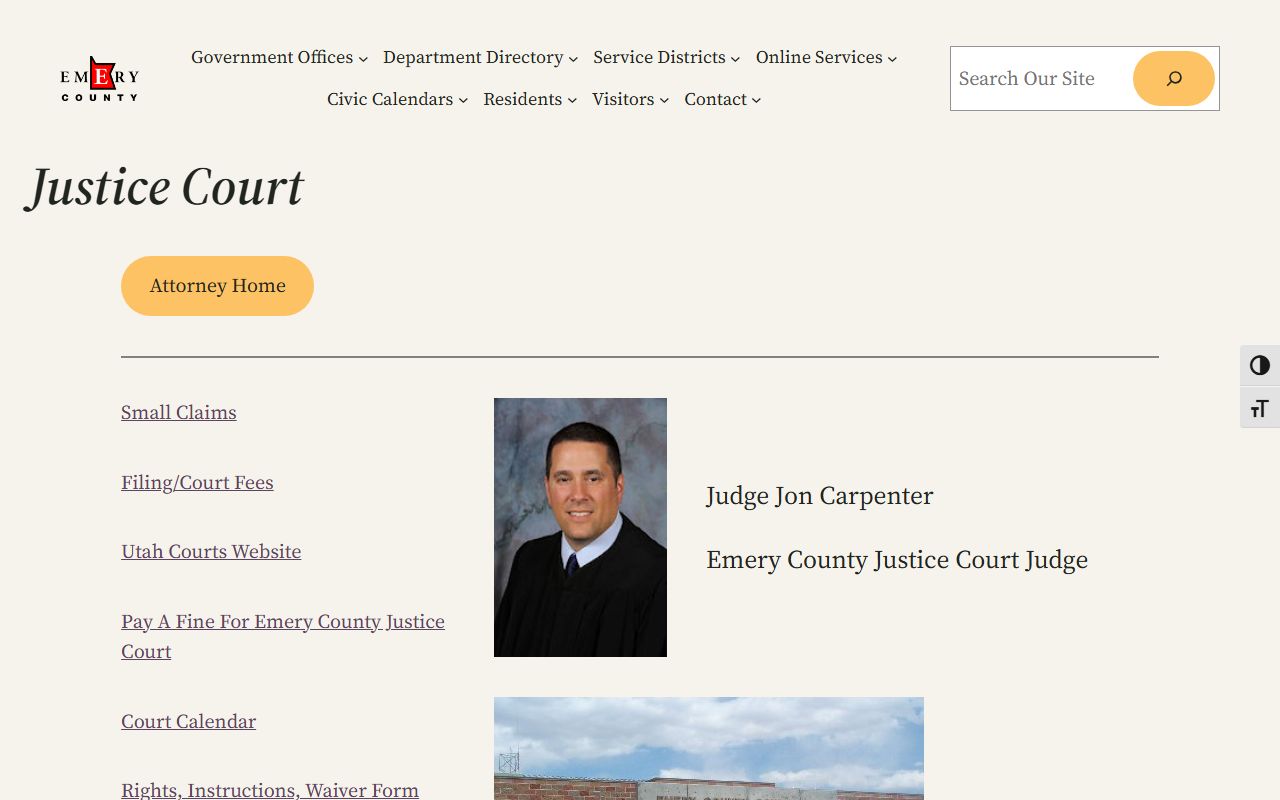
The Justice Court source is useful when a post-arrest case involves a citation, misdemeanor, local warrant, or court appearance in Castle Dale.
Detention Facility Tied to Emery County Arrest Cases
Official research supports one local detention facility for this site. Emery County Jail is operated by the Emery County Sheriff's Office and serves local pretrial detainees, short county sentences, local holds, and a limited number of Utah Department of Corrections contract inmates. It is the custody-side facility, while Xchange, MyCase, Justice Court, District Court, and the County Attorney are the court-record side of the same post-arrest path.
- Emery County Jail - 1850 North Des Bee Dove Road / 1850 North 550 West, Castle Dale, UT 84513; phone (435) 381-2404.